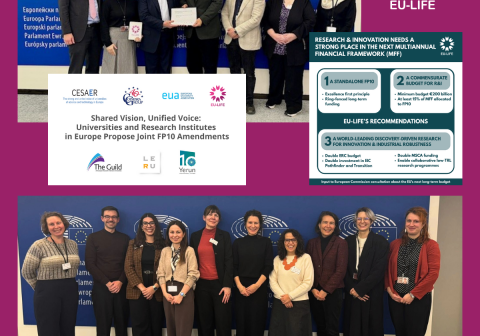
European Parliament draft reports provide strong basis for FP10 discussions
Last week, the European Parliament draft reports on the future of the EU’s next Framework Programme for Research and Innovation (FP10), prepared by Members of the European Parliament Christian Ehler and René Repasi, were released. From EU-LIFE’s initial analysis, the reports represent strong and thoughtful contributions that significantly improve on the European Commission’s initial proposal.
Overall, the reports mark an important step forward for FP10 and the general direction they outline deserves strong support. In particular, the emphasis on excellent, investigator-driven, bottom-up research and on reinforcing excellence across the programme is a very positive signal for the European research community.
The proposals to strengthen the independence and governance of the European Research Council (ERC) and the European Innovation Council (EIC), alongside a stronger role for expert-led guidance in programme implementation, are important steps to safeguard quality and ensure long-term impact.
The reports also highlight the need to strengthen bottom-up collaborative research across the full research continuum, including frontier research. Strengthening such collaborative approaches, especially within Pillar II, could contribute to build stronger research ecosystems. On Widening, the approach outlined appears constructive and could provide a useful basis for building broader consensus across Europe’s research landscape. Other elements in the reports also merit attention, including clearer boundaries between research and deployment activities, as well as the recognition of research infrastructures as key promoters of excellent research.
EU-LIFE strongly supports the proposal for a €220 billion budget for FP10. At this level of ambition, funding should prioritise programmes that are currently most stretched and deliver the greatest value for Europe, notably the ERC, the EIC and the Marie Skłodowska-Curie Actions (MSCA). Doubling the ERC budget would represent a crucial investment in Europe’s scientific leadership. If difficult trade-offs are required in the negotiations ahead, they should not come at the expense of these core excellence-driven instruments, either by reducing their proposed increases or by introducing new schemes within them.
Finally, we would like to thank the rapporteurs, Christian Ehler and René Repasi, for their work in preparing these reports and for their continued engagement with the research and innovation community. As discussions on FP10 progress in the coming months, the European Parliament reports provide a strong and constructive basis for shaping the programme. EU-LIFE stands ready to engage constructively in the negotiations ahead to help further refine the proposal and ensure that FP10 strengthens Europe’s scientific leadership and research ecosystem.
Read Ehler’s report: https://www.europarl.europa.eu/doceo/document/ITRE-PR-785237_EN.pdf
Read Repasi’s report: https://www.europarl.europa.eu/doceo/document/ITRE-PR-781461_EN.pdf